
The eight questions clients ask a law firm website, ranked by how often they're answered
We scored 125 small law firm websites on the eight questions clients ask before choosing. 91% give each practice area its own page; only 43% say where their lawyers are licensed.
- A typical small law firm website answers four of the eight questions clients ask before choosing a lawyer, across 125 sites scanned (Clikiti Research, October 2026).
- 91% give each practice area its own page, but only 43% say where their lawyers are licensed and 45% show client reviews.
- The four least-answered questions sit between 39% and 46%, and three of them are rated quick fixes in the report.
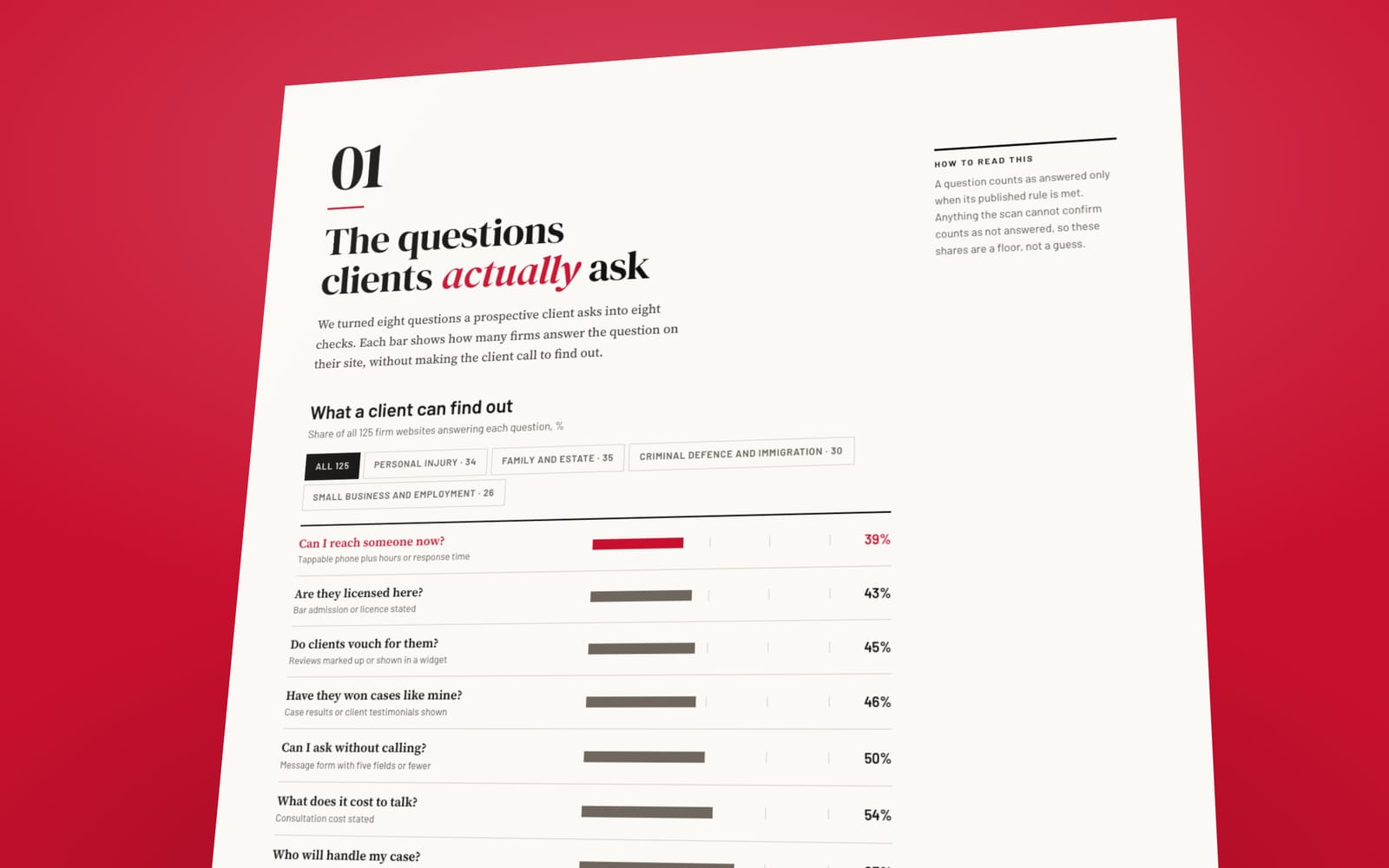
A client choosing a lawyer from a website is trying to settle a few things before making contact: who will handle the case, whether that lawyer can practise in their state, what a first conversation costs and how quickly someone will respond. The study turns these into eight questions, each with a written rule for what counts as an answer.
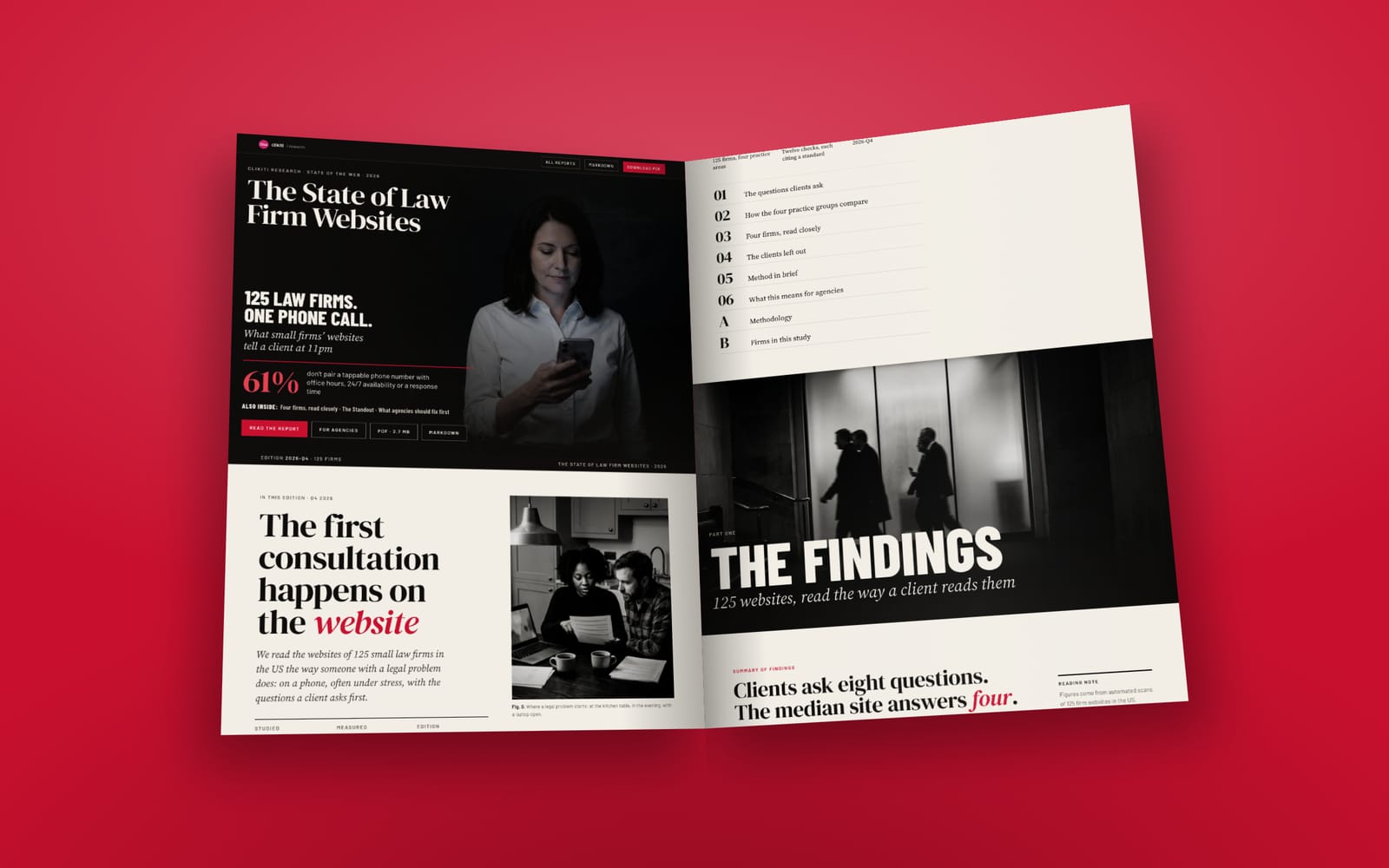
In The State of Law Firm Websites 2026, Clikiti Research scored 125 solo and small law firm websites in four practice groups against those eight questions. A typical site answers four of the eight (mean 4.3). The spread between questions is wide: the best-answered question passes on 91% of sites, the least-answered on 39%.
Share of sites that answer each question
125 websites · Law firms · Q4 2026
What follows takes the eight in order, from least to most answered. Each entry gives the share of sites that pass, what a passing site shows, and one line for an agency deciding what to raise with a prospect.
How was each question scored?#
A question counts as answered only when the scan finds the answer on the home page or a page it links to: the attorneys, about, practice areas, results, reviews and contact pages, plus one lawyer's profile. The scan reads each page as the server delivers it. Content that appears only after scripts run in the browser, such as some review widgets and contact forms, is not seen and counts as a gap.
The shares are exact for the 125 sites. Read as estimates for all small law firm websites, they carry a margin of error of up to 8.8 points either way at a 95 percent confidence level. The scan records whether an answer is there, not why it is missing, and it does not assess whether any firm meets its state bar's advertising rules.
The scorecard, least answered first#
1. Can I reach someone now? 39%
Passing looks like: a phone number on the home page that a phone can dial with one tap, with office hours, 24/7 availability or a response time stated on the home or contact page.
For the agency: the lowest score in the study. Our playbook on the after-hours header covers the check and the fix in full; start there if the prospect fails it.
2. Are they licensed here? 43%
Passing looks like: a profile, attorneys or about page that states where the lawyer is admitted or licensed to practise, in plain words such as "admitted to the Ohio bar".
For the agency: 57% of sites leave a careful client to check this somewhere else. One line on each lawyer's profile, with the state and the year of admission, is a quick fix the firm can write itself.
3. Do clients vouch for them? 45%
Passing looks like: client reviews shown on the site through a review widget, or marked up with Review or AggregateRating structured data.
of the 125 websites we scanned answer “Do clients vouch for them?” (reviews marked up or shown in a widget).
For the agency: look the firm up on a review platform before the meeting. If it has reviews there and none on its own site, that is the gap to show. If it has a widget, open the page source and check whether the reviews are in the HTML or only drawn in by a script.
4. Have they won cases like mine? 46%
Passing looks like: case results, verdicts, settlements or client testimonials shown on the site.
For the agency: 54% of sites show none. This is content only the firm can supply, and what a firm may say about past results is a matter for its own bar's rules, which the study does not assess. Offer the page and its structure; let the firm write and clear the wording.
5. Can I ask without calling? 50%
Passing looks like: a message form on the home or contact page, present in the page as the server delivers it, with five fields or fewer to fill in.
For the agency: half the sites fail. Some of them may have a form that a script draws after the page loads, which the scan cannot see and which a slow phone may not show either. Check two things: how many fields the form asks for, and whether it appears in the page source.
6. What does it cost to talk? 54%
Passing looks like: a stated price for a first conversation: a free consultation or case review, a fixed consultation fee, or no fee unless the case is won.
of the 125 websites we scanned answer “What does it cost to talk?” (consultation cost stated).
For the agency: personal injury firms state a consultation cost more often than business firms in the study. With a business or employment prospect, check this question early.
7. Who will handle my case? 63%
Passing looks like: at least one lawyer named, with a page of their own in an attorneys, team or people section of the site.
For the agency: 37% of sites don't name a lawyer with a profile page. Profiles are also where the admission line from entry 2 belongs, so the two fixes can be quoted as one job.
8. Do they handle my kind of case? 91%
Passing looks like: at least three practice areas, each with its own page, linked from the home page or the practice areas page.
For the agency: the one question almost every firm answers. Use it in the pitch. A site with a page for every practice area has already shown it can publish; the gaps above are about what is on those pages, not whether the firm can produce content.
What does the ranking tell an agency?#
The order is the useful part. Firms describe the work they do. They are less consistent about the firm itself: licensing, reviews and past results, the things a client uses to judge a firm they have never met, all sit between 43% and 46%.
That shapes the pitch. A firm that passes the practice-area question has a working site and a habit of publishing. The bottom four are mostly short additions to pages it already has: a line in the header, a line on each profile, a reviews block, a results page. The report rates contact, licensing and reviews as quick fixes.
Practice group matters less than the individual site. Median overall scores sit within four points of each other:
| Practice group | Sites | Median score |
|---|---|---|
| Personal injury | 34 | 77 |
| Family and estate | 35 | 75 |
| Criminal defence and immigration | 30 | 77 |
| Small business and employment | 26 | 79 |
Family and estate firms have the lowest median, 75 out of 100, which makes them the most winnable group in the report. But the scorecard, run on one prospect's site, tells you more than its group does.
How do you pitch it?
- Score the prospect on all eight. Open the site on a phone and go down the list. Mark each question pass or fail, and note the page where the answer should be.
- Place them against 125 firms. A typical site answers four of the eight. A firm that answers three has a clear reason to act; one that answers six has a short list to finish.
- Quote the bottom of their list first. Contact, licensing and reviews are each rated a quick fix in the report. Price them as one content project before you raise a rebuild.
Your site says what cases you take. It doesn't say where you're licensed, what a first meeting costs or what clients say about you.
The same pattern shows up outside law. Dental practices publish their opening hours but leave out which insurance they take: sites carry the facts a business thinks to publish and skip the ones a customer checks first. For law firms, every question is broken down by practice group in the full report.
Keep reading
More on law and the same problems in other industries



How to cite
Clikiti Research (2026, October 15). The eight questions clients ask a law firm website, ranked by how often they're answered. Clikiti. https://splash.clikiti.com/research/posts/law-firm-websites-eight-client-questions
Data and license
Every number comes from The State of Law Firm Websites 2026 (n = 125). Free to reuse under CC BY 4.0. Credit Clikiti with a link. Plain Markdown
About the images
People in the photographs on this page are AI-generated. No real person, school, firm or practice is shown. Last updated Oct 15, 2026.
One stat. One pitch. Every Tuesday.
A finding from our scans, what it means for the agencies selling to that industry, and the line to open a pitch with. Free.