
The pitch deck in five slides: selling a website to a moving company owner
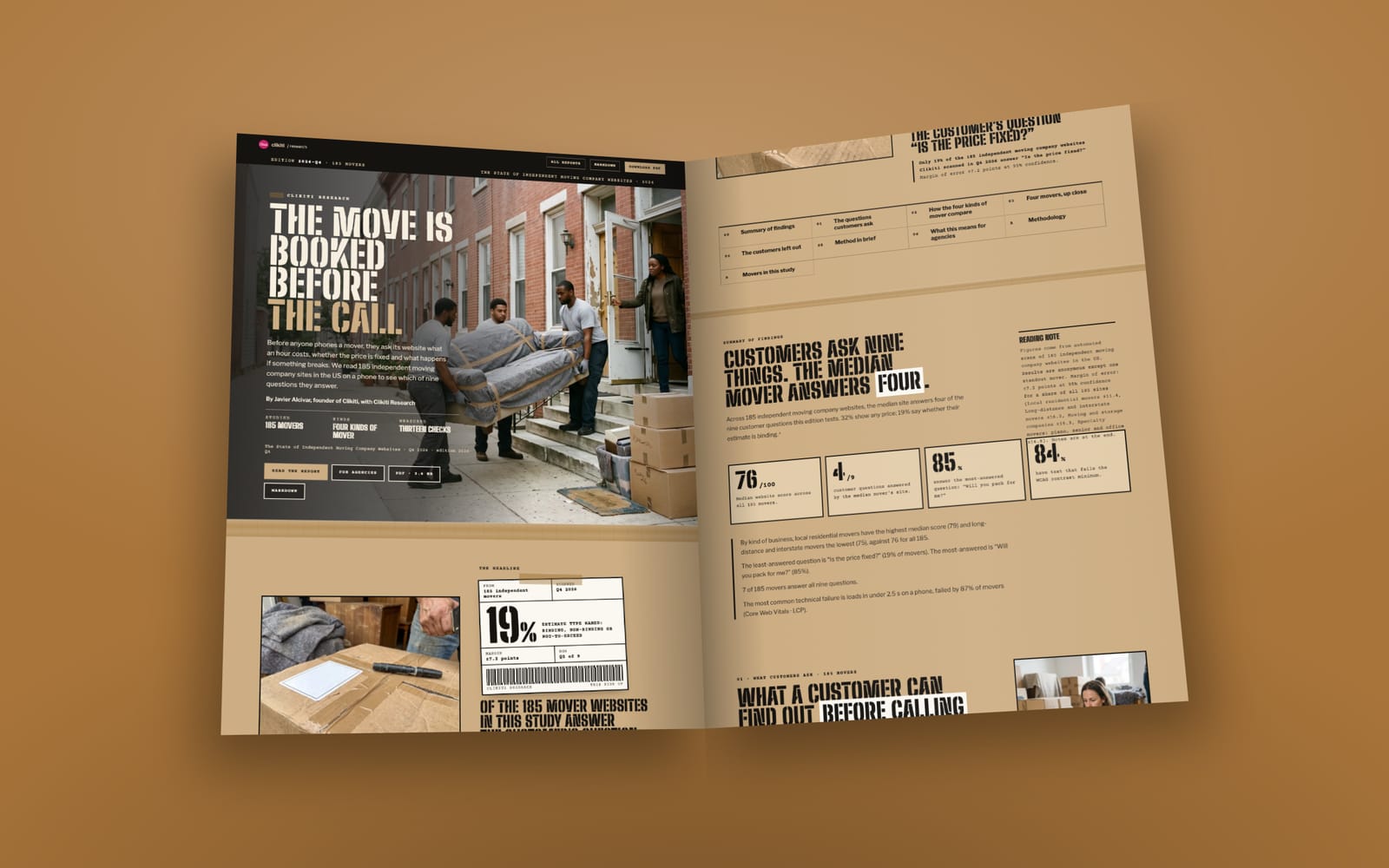
Only 19% of the 185 independent moving company websites we scanned say whether their estimate is binding. Here is a five-slide deck for pitching a mover, each slide built on one number from the study, with speaker notes and the slide text.
- Only 19% of 185 independent moving company websites say whether their estimate is binding, non-binding or not-to-exceed (Clikiti Research, October 2026).
- The deck has five slides, one number each: the estimate type (19%), the deposit and cancellation terms (24%, and 5% of moving and storage companies), the USDOT or MC number (43%), what happens if something breaks (31%) and the hourly rate (32%).
- Every slide ends on a fix the owner can see the size of. Most are a paragraph of copy or a footer line; the price list is the one that takes a meeting.
A moving company owner does not sit through a 30-slide agency deck. They run dispatch from a phone, they have a crew loading a truck while you talk, and they know their business cold. What they don't know is what their website looks like to a customer comparing three movers at night. This deck shows them, in five slides, each built on one number.
The numbers come from The State of Independent Moving Company Websites 2026, our scan of 185 independent local, long-distance, storage and specialty movers in the US, read against nine questions a customer asks before booking a move. Only 19% of them say whether their estimate is binding, non-binding or not-to-exceed. That is the least-answered question in the study, and it is slide one.
of the 185 websites we scanned answer “Is the price fixed?” (estimate type named: binding, non-binding or not-to-exceed).
Before the meeting, open the prospect's site on your phone and check the five items below. Each slide has a line for what you found on their site. If they already pass one, drop that slide and say so. Four honest slides beat five padded ones.
Slide 1: Is the price fixed?#
Is the price fixed? 19% of 185 independent movers say on their website whether the estimate is binding, non-binding or not-to-exceed. Your site: does not say.
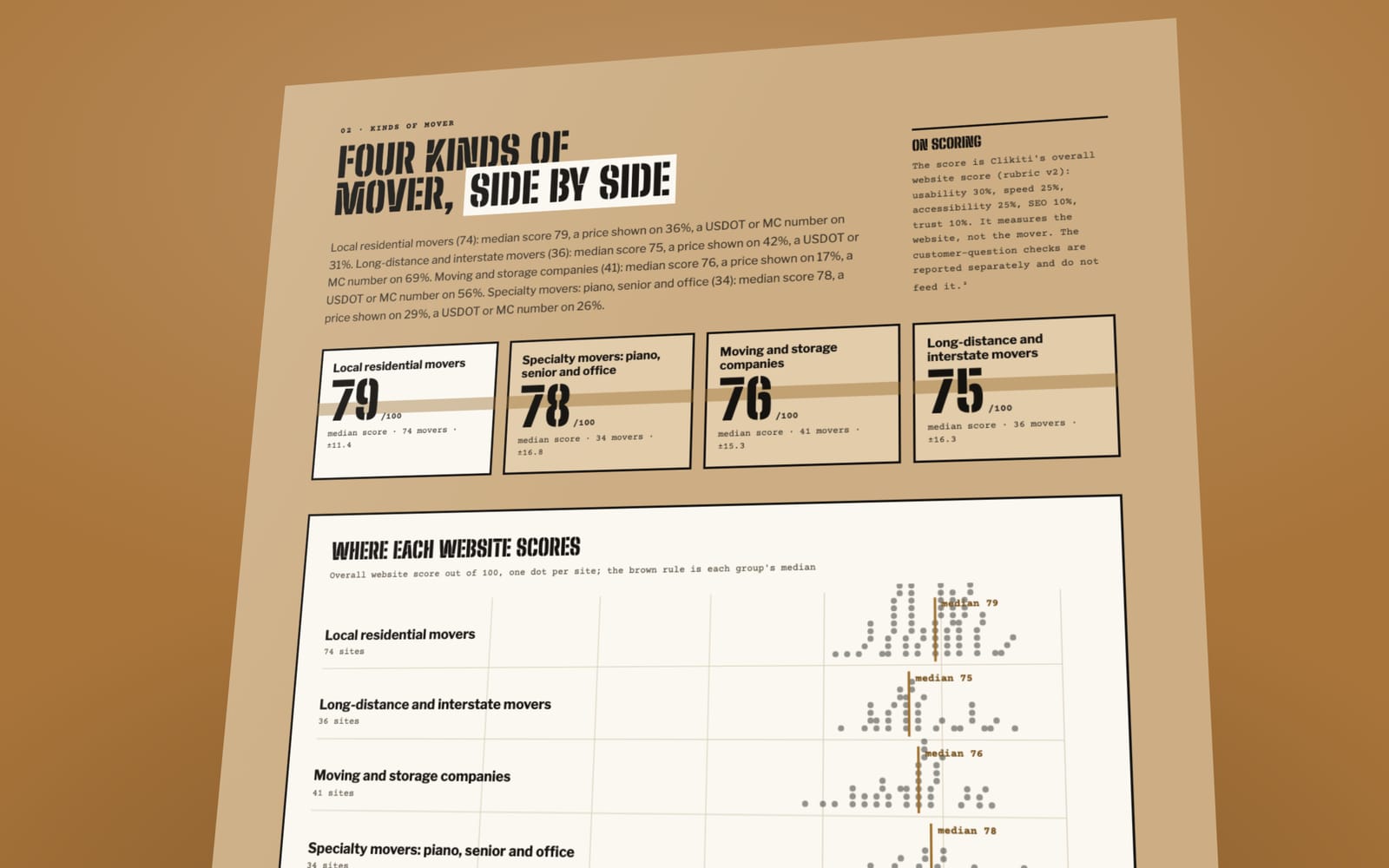
Speaker notes. Most bad mover stories start with a price that changed on moving day. The scan passed a site when it named the estimate type on a page a customer could reach from the home page: binding, non-binding, not-to-exceed, or a guaranteed price. Long-distance movers name it most (31%); specialty movers least (12%). The fix is one paragraph, linked from the quote form, saying which kind of estimate the company gives and what can change the price on the day. Ask the owner which estimate they actually give. They will know in one sentence; that sentence is the copy.
Slide 2: What's the deposit, and can I cancel?#
What does a customer lose if the closing date moves? 24% of independent movers state a deposit or cancellation terms on their site. Among moving and storage companies, 5%. Your site: no deposit or cancellation terms.
Speaker notes. A customer about to commit has one more question: what happens to my money if the date moves? Fewer than a quarter of the sites answer it, and moving and storage companies almost never do. This is the quickest fix in the deck. Ask the owner for their actual policy (the amount or "no deposit", the notice period, the fee) and put it next to the quote form and in the FAQ. If the policy is "no deposit and free rescheduling", that is a selling point the site is hiding.
Slide 3: Are you licensed to move me?#
Can a customer check you before they call? 43% of independent movers show a USDOT or MC number as text. Long-distance movers: 69%. Local movers: 31%. Your site: number missing, or only inside a badge image.
Speaker notes. Careful customers look up a mover's USDOT number on the federal register before booking, and the advice to do so is everywhere. The scan only counted numbers written as text; a number inside a badge image can't be copied into the lookup. Local movers show it least. A customer doesn't know which moves need which number; they look for one, and leave if it isn't there. The fix is a footer line with the USDOT number, the MC number if they have one, and any state licence, linked to the federal lookup. Ten minutes of work, and it is on every page.
Slide 4: What if something breaks?#
What does basic coverage pay? 31% of independent movers explain how a customer's belongings are covered: released value, full value protection or the cover they offer. Your site: "licensed and insured", nothing more.
Speaker notes. This is the slide the owner will feel. Released value protection pays 60 cents per pound per article, and customers learn that after something breaks, usually in a one-star review. The scan did not count a bare "licensed and insured"; it wanted the options explained. Long-distance movers do it on half their sites (50%); local movers on 24%. The fix is a short page: what basic protection pays, what full value protection costs, how to file a claim. The owner explains this on the phone every week; the page saves them the call and the review.
Slide 5: What does an hour cost?#
What does a customer pay for two movers and a truck? 84% of independent movers take a quote request online. 32% show any price. Your site: quote form, no rate.
Speaker notes. Most movers have done the hard part: the quote form works. But only about a third publish a price, and moving and storage companies the fewest (17%). Every lead still starts with a call to find out the rate. The fix is a short rate table: crew size, hourly rate, minimum hours, how travel time is charged. This is the slide that takes a meeting, because the owner has to commit to numbers in public. Offer to publish "from" rates first if they won't publish the full table.
Closing slide: the offer#
Four paragraphs and a footer line. Estimate type, deposit and cancellation, coverage, rates, USDOT number. Live on your site in two weeks. Rerun the same checks after.
Keep the offer to what the five slides found. Price it as a fixed job, not a redesign, and promise to rerun the same checks on their site afterwards so the owner sees the before and after on the same terms.
How do you pitch it?
- Lead with slide 1, not with design. The estimate question is the one every owner has fought on the phone. Show them it is unanswered on their site and on four in five of their competitors'.
- Make every slide about their site. Fill the "Your site" line from the prospect's own pages before the meeting. A slide that doesn't apply gets dropped.
- Sell the fixed job, then the redesign. Four paragraphs and a footer line are easy to say yes to. The redesign conversation comes after the owner has seen the checks pass.
"Is the price fixed?" is the question behind every bad mover story, and your site never answers it.
For the clauses behind each slide, with what a customer should have in writing before booking, read the fine print audit. For another trade sold on a single page, see the quote request form for landscaping companies.
Keep reading
More on moving and the same problems in other industries



How to cite
Clikiti Research (2026, October 15). The pitch deck in five slides: selling a website to a moving company owner. Clikiti. https://splash.clikiti.com/research/posts/moving-company-pitch-deck-five-slides
Data and license
Every number comes from The State of Independent Moving Company Websites 2026 (n = 185). Free to reuse under CC BY 4.0. Credit Clikiti with a link. Plain Markdown
About the images
People in the photographs on this page are AI-generated. No real person, school, firm or practice is shown. Last updated Oct 15, 2026.
One stat. One pitch. Every Tuesday.
A finding from our scans, what it means for the agencies selling to that industry, and the line to open a pitch with. Free.