
The letter: how to write to an independent funeral director about their website
A funeral director does not answer cold email sequences. This is a respectful one-page letter an agency can send instead, paragraph by paragraph: why each line is there, the four numbers from our study of 175 funeral home websites it rests on, and what to offer if the director writes back.
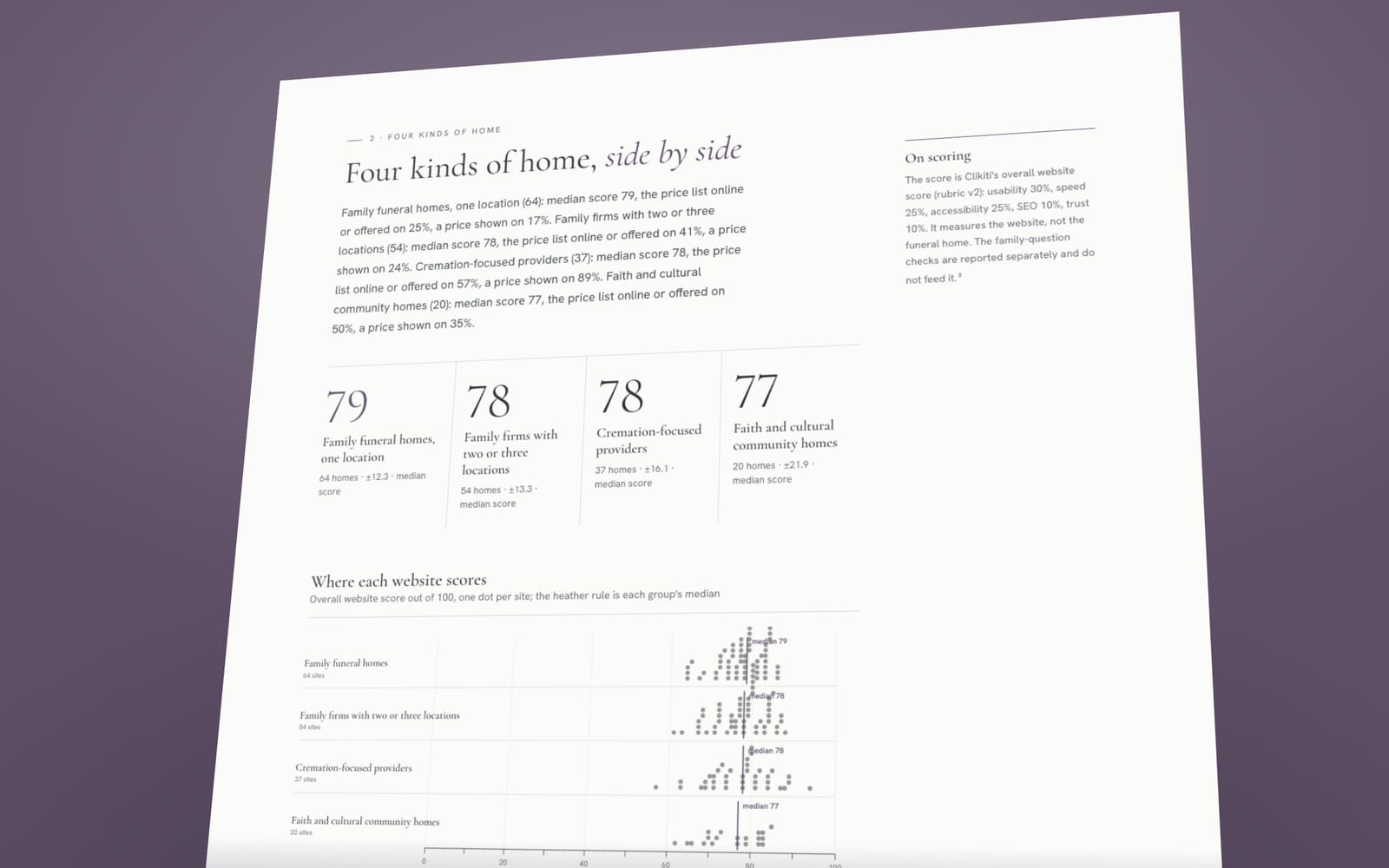
- Only 39% of 175 independent and family-owned funeral home websites publish or offer their General Price List, and 37% show a price for cremation or a burial (Clikiti Research, October 2026).
- 13% name a religious or cultural tradition the home serves, and 22% say a service can be watched online.
- One page, on paper, with two numbers and one offer, is a better first approach to a funeral director than a sequence of emails.
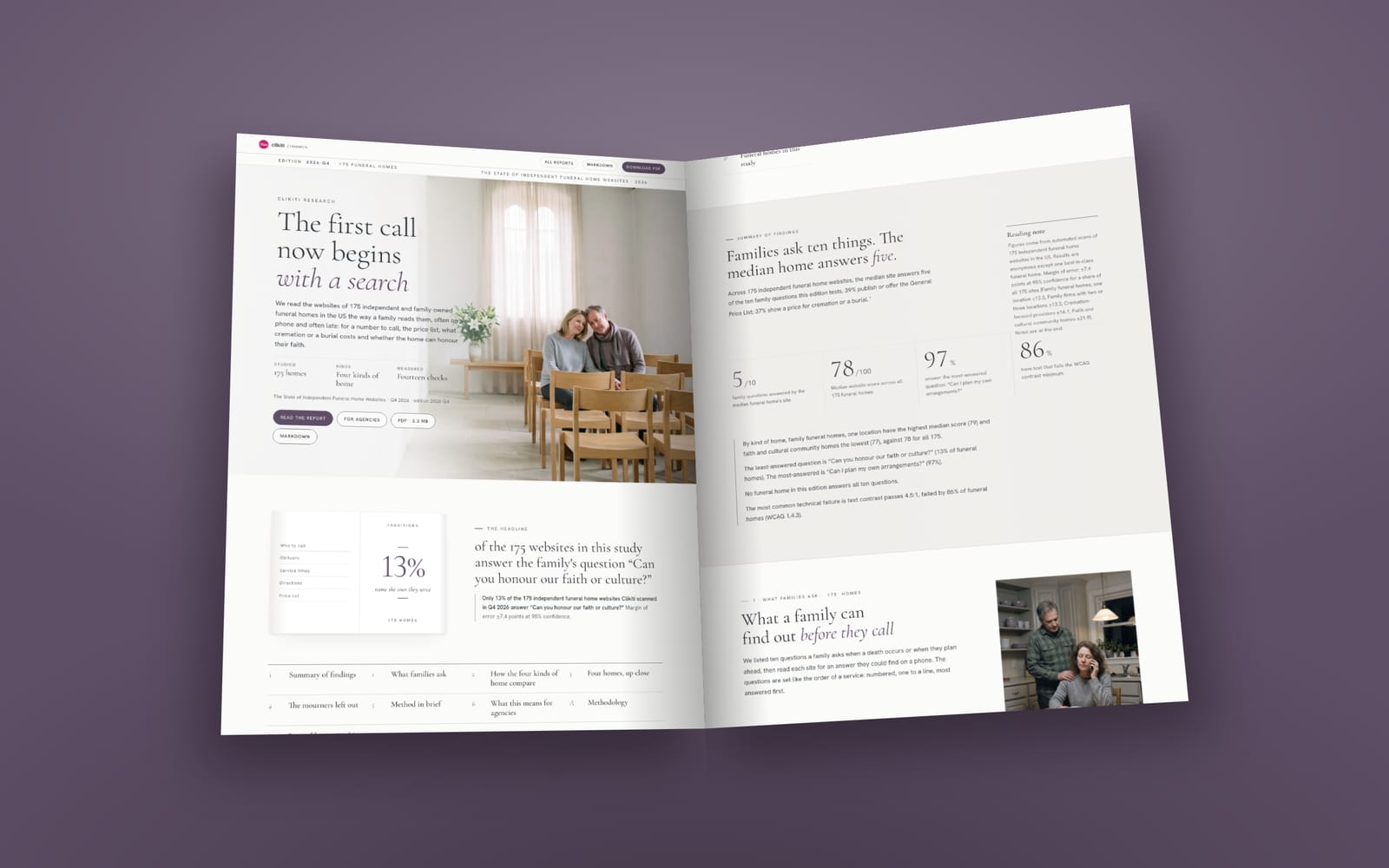
Funeral directors are careful with words, because their work depends on it. Most of them are also the second or third generation of the family whose name is on the building, and they have been sold to before. A sequence of follow-up emails reads to them as pressure. A short, signed letter reads as someone who took the time to look.
This playbook sets out that letter, one paragraph at a time. The numbers come from The State of Independent Funeral Home Websites 2026, our read of 175 independent and family-owned funeral homes, from single locations to small family firms, cremation providers and homes that serve a faith or cultural community. The one to build the letter on: only 39% of the sites publish or offer the General Price List.
of the 175 websites we scanned answer “Can I see your price list?” (general price list online or offered).
Why a letter and not an email sequence?#
Because the reader is deciding whether you are the kind of person they would let near a family. A letter is slower, it can be read twice, and it can be passed to a son or daughter who now runs the website. It asks for nothing urgent. Send it on paper to the home, addressed to the director by name, and send the same text by email only if the home lists one for general enquiries.
Before you write, read the home's site on a phone and note what you find. The letter below assumes the two most common gaps in the study: the price list is not on the site, and no tradition is named. Change the second paragraph if the home's gaps are different.
Paragraph one: who you are and why you looked#
The opening says who you are in one sentence and why you looked at this home, and nothing else. It does not praise the site and it does not criticise it. Funeral directors hear flattery as a sales tactic.
I build websites for a small number of family businesses in this region, and I have been studying how independent funeral homes present themselves online. I read your site as a family would, on a phone, and I wanted to share what I found rather than ask for anything.
Paragraph two: what you found, with one number#
This is the paragraph that earns the reply. It names one thing the home's own site does not show, then places it in the study so it does not feel like an accusation. 61% of the homes we read do not publish or offer their price list online. A director who learns that most of their peers miss the same thing hears information, not blame.
Your General Price List is not on your website. You are far from alone in this: in a study of 175 independent funeral homes this autumn, 61% did not publish or offer their price list online, and 63% showed no price for cremation or a burial. The Funeral Rule asks you to hand the list to anyone who asks in person; it says nothing about a website. Many families now look before they call, and the homes that show the list are the ones they can compare.
If the home already publishes its list, use the price instead: 37% of sites show a price for cremation or a burial, and among one-location family homes only 17% do. Cremation-focused providers show one on 89% of their sites, which is the comparison a family makes.
Share of sites that answer each question
175 websites · Independent funeral homes · Q4 2026
Paragraph three: what the home already does well#
A letter that lists only gaps reads as a critique. Name one thing the home's site does that most do not, after you have checked it is true. Obituaries (93% of sites) and pre-planning (97%) are too common to be a compliment. A tradition named, a livestream offered, a 24-hour number a family can tap: those are rarer, and a director knows it took effort.
I also noticed that your site names the traditions you serve and the customs you can arrange. Only 13% of the homes in the study do that. It is the kind of detail a family looks for, and you have already done the harder part.
I also noticed that your site tells families a service can be watched online. Only 22% of the homes in the study say so, and for relatives who cannot travel it is often the first thing they look for.
Paragraph four: the offer, small and specific#
One offer, sized so it can be accepted without a meeting about a redesign: put the price list on the site, linked from the home page and the pricing page, with its date. It is a quick fix, and a director can say yes to it by return post.
If it would help, I can add your current price list to your website as a page that reads well on a phone, with a link from the home page, and send you the page to approve before anything goes live. There is no cost to see it. If you would rather not, I will not write again.
The last sentence matters most. It tells the director that silence is an acceptable answer, which is the reason many of them will reply.
Paragraph five: the close#
Close with your name, a phone number and a line that you are local, if you are. Sign it by hand. Do not add a postscript with a second offer.
Thank you for reading this. I know how much of your week belongs to families, and I am grateful for a few minutes of it.
What should you offer if they reply?#
If the director replies, they will usually ask what it involves. Send the price list page first, as promised, then one short note with the next three things the study found missing most often, each with its share:
- Traditions. 87% of sites name no tradition. A page listing the faiths and cultures the home serves, the customs it can arrange and the clergy it works with.
- Livestreams. 78% never say whether a service can be watched. One line on the services page, and each stream link on that service's obituary page.
- Contrast. 86% of sites have text below the WCAG contrast minimum, often in the obituaries older relatives read. A theme change, done in an afternoon.
How do you open it?
- Write, don't sequence. One signed letter on paper, addressed by name. No follow-up unless they reply.
- One gap, one number. "Your price list exists, and the website does not show it." 61% of 175 independent homes are in the same place.
- Offer the page, not the site. Build the price list page for approval at no cost. The larger work follows only if they ask.
Families compare homes before they call. Your price list exists, and the website does not show it.
For a sequence that does suit a different trade, compare the three cold emails to a vet clinic owner. For the rule itself and what the 175 sites show section by section, read what the FTC Funeral Rule asks of price lists, and what websites do.
Keep reading
More on funeral homes and the same problems in other industries
What the FTC Funeral Rule asks of price lists, and what 175 funeral home websites do
The intake worksheet: nine questions to ask a wedding venue owner on the first call

Take the class first: a field-visit playbook for pitching an independent gym
How to cite
Clikiti Research (2026, October 15). The letter: how to write to an independent funeral director about their website. Clikiti. https://splash.clikiti.com/research/posts/funeral-home-letter-to-a-director
Data and license
Every number comes from The State of Independent Funeral Home Websites 2026 (n = 175). Free to reuse under CC BY 4.0. Credit Clikiti with a link. Plain Markdown
About the images
People in the photographs on this page are AI-generated. No real person, school, firm or practice is shown. Last updated Oct 15, 2026.
One stat. One pitch. Every Tuesday.
A finding from our scans, what it means for the agencies selling to that industry, and the line to open a pitch with. Free.