
The fine print audit: what 185 mover websites put in writing before you book
Only 19% of the 185 independent moving company websites we scanned say whether their estimate is binding. We audited the fine print a customer should have in writing before booking a mover, clause by clause: the carrier number, the estimate type, the rate, the coverage, the deposit and cancellation terms.
- Only 19% of 185 independent moving company websites say whether their estimate is binding, non-binding or not-to-exceed (Clikiti Research, October 2026).
- The rest of the fine print is thin too: 43% show a USDOT or MC number as text, 32% show any price, 31% explain what happens if something breaks and 24% state a deposit or cancellation terms.
- Each clause is a paragraph or a footer line. An agency that adds all five closes the gap a customer checks before booking.
A move is a contract with a truck attached. The customer hands over everything they own, and what protects them is a handful of terms: who the carrier is, whether the price can change, what an hour costs, what basic coverage pays, and what they lose if the date moves. A good dispatcher can recite all five on the phone. The question is whether the website says them before the customer calls.
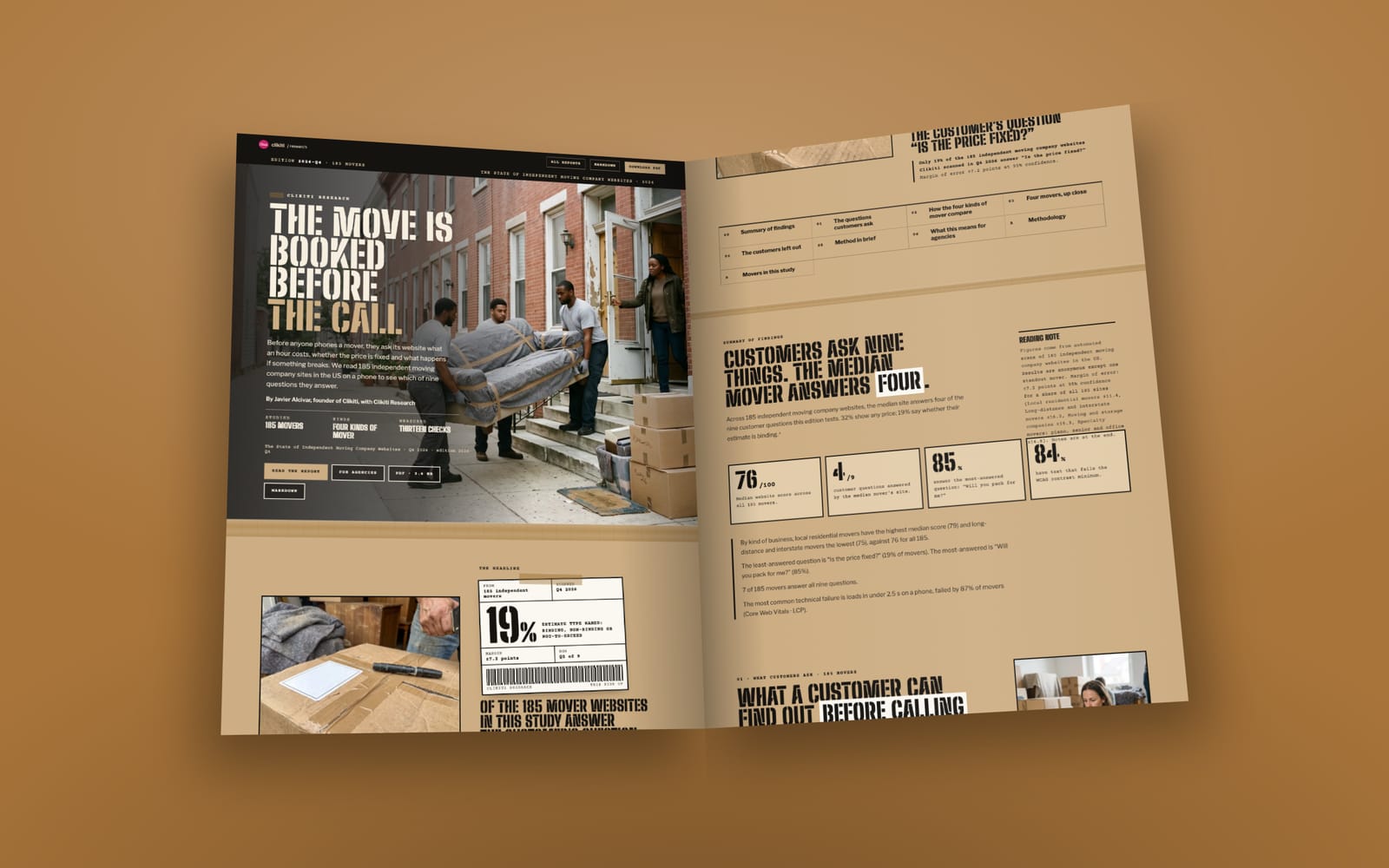
We checked. The State of Independent Moving Company Websites 2026 scanned 185 independent local, long-distance, storage and specialty movers in the US and read each site the way a customer does on a phone. Only 19% say whether their estimate is binding, non-binding or not-to-exceed. Below is the audit, one clause at a time, with the share of sites that put it in writing.
of the 185 websites we scanned answer “Is the price fixed?” (estimate type named: binding, non-binding or not-to-exceed).
How did we read the fine print?#
The scan read the home page and up to eleven pages it links to: services, quote, prices, packing, storage, long distance, insurance or valuation, the FAQ, policies or terms, reviews and contact. Blog posts were not read; they describe the trade, not the mover. Each clause has a fixed pass rule, written before any site was read, and each pass records the text that earned it. We sampled those passes and fails rule by rule and tightened the rules wherever advice or a customer review was being counted as the mover's own term.
What this does not do: check that any number is valid, any policy is honoured, or any price is fair. It reports what a customer can read before calling.
Clause 1: Who is the carrier?#
43% show a USDOT or MC number as text.
A carrier number is the one thing a customer can check without trusting the mover. The federal lookup shows whether the company is authorized and what its record looks like. The scan counted a number only when it was written as text; a number buried in a badge image can't be copied into the lookup, and it can't be read aloud by a screen reader either.
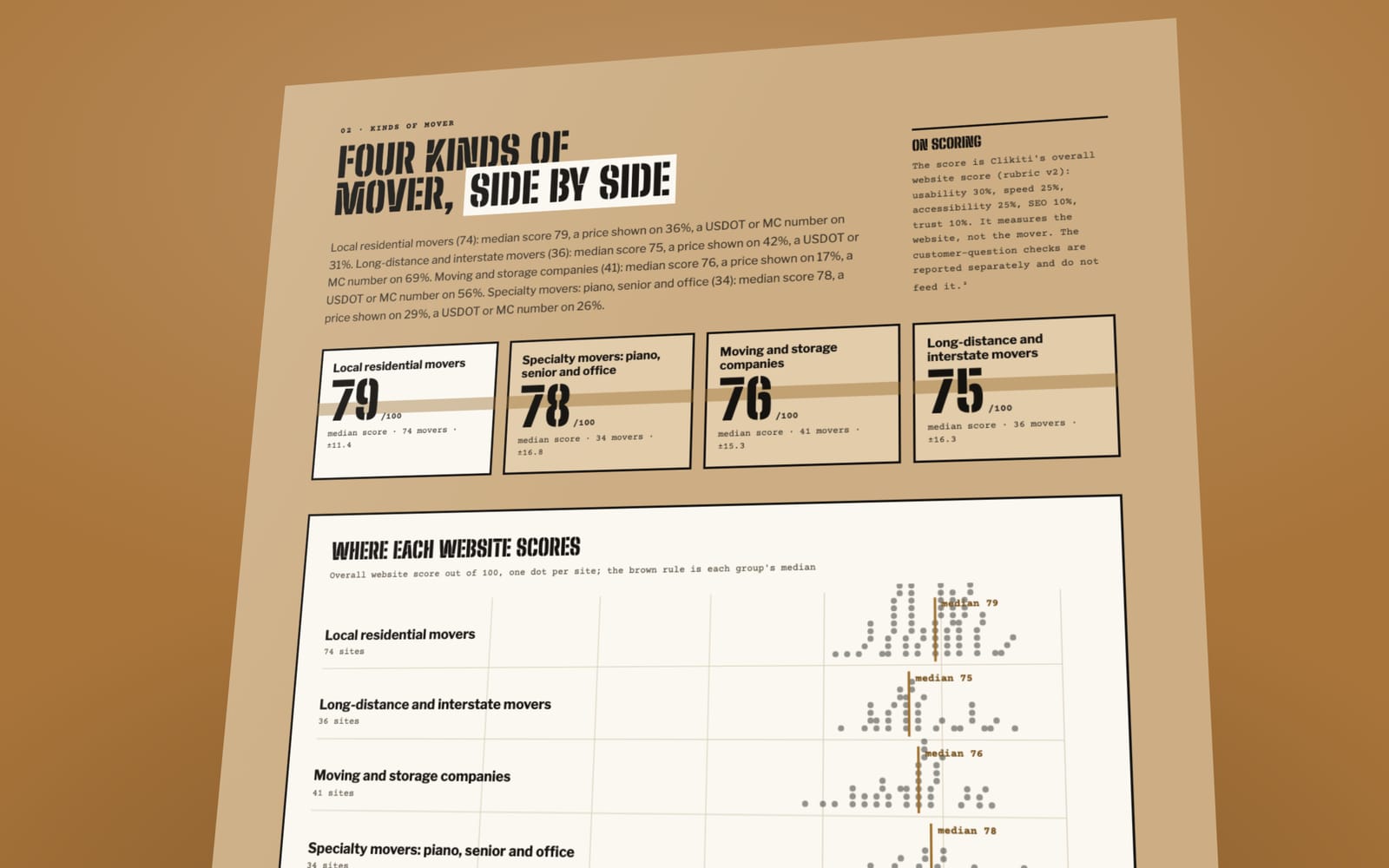
The split by kind of mover is sharp. Long-distance and interstate movers show the number on 69% of their sites. Local movers show it on 31%. The scan can't say whether a mover without the number on its site holds one. Neither can the customer, and that is the problem.
Clause 2: Is the price fixed?#
19% name the estimate type.
This is the clause behind most moving horror stories, and it is the least-answered question in the study. A binding estimate holds the price. A non-binding estimate can move with the actual weight or hours. A not-to-exceed estimate caps it. Each is legitimate; what matters is that the customer knows which one they are getting before they book.
Long-distance movers name it most often (31%), which makes sense: interstate estimates come with federal rules attached. Specialty movers name it least (12%). On a local hourly move the honest answer may be "it's hourly, here's what changes the total", and that answer counts too. Silence does not.
Clause 3: What does an hour cost?#
32% show any price.
The scan counted a dollar amount tied to the move itself: an hourly rate, a crew rate, a flat price for a home size, a per-mile rate or a monthly storage price. Coupons, deposits, tips and averages for the whole city did not count.
Meanwhile 84% take a quote request online. Most movers have built the form and left out the rate, so every quote request still turns into a phone call. Moving and storage companies are the least likely to show a price (17%). The sites that do it well show a crew size next to the rate, the minimum hours and how travel time is charged.
Clause 4: What if something breaks?#
31% explain how belongings are covered.
Basic released value protection pays 60 cents per pound per article. A customer who learns that after the move learns it from a broken lamp. The scan passed a site when it explained released value, full value protection, valuation options or the cargo cover it offers the customer. "Licensed and insured" on its own did not pass; it describes the mover, not the customer's belongings.
Long-distance movers explain it on half their sites (50%). Local movers do on 24%. The gap has the same shape as the carrier number: long-distance movers write it down far more often than local ones.
Clause 5: What's the deposit, and can I cancel?#
24% state a deposit or cancellation terms.
The scan counted either: a deposit (an amount, a share, or a plain "no deposit"), or the cancellation and rescheduling terms (a notice period, a fee, a refund). An FAQ question with no answer did not count, and neither did advice about what other movers charge.
Moving and storage companies, the businesses most likely to hold a customer's goods for weeks, state these terms on 5% of their sites. A closing date that slips is the most ordinary thing in a move. The customer wants to know what it costs them before they sign, not after.
What does a site with the fine print look like?#
The best-in-class site in the study, Abe Lincoln Movers and Storage in Denver, answers eight of the nine customer questions. Its home page puts a written not-to-exceed quote, typical local prices, its MC number, basic valuation at 60 cents per pound and the booking lead times on one page a customer can read in a few minutes. It still doesn't state a deposit or cancellation terms, which is one paragraph away.
How do you pitch it?
- Read their fine print back to them. Open the prospect's site on your phone and go clause by clause: carrier number, estimate type, rate, coverage, deposit. Say which ones a customer can find.
- Ask for the sentence, not the strategy. The owner already knows their estimate type and cancellation policy. Your job is to get it on the page.
- Start with the footer and the FAQ. The carrier number and the deposit terms are quick fixes; the rate table is the one that takes a meeting.
"Is the price fixed?" is the question behind every bad mover story, and your site never answers it.
The five-slide pitch deck turns these clauses into a ten-minute meeting with an owner. For the same read on another trade where customers check credentials before they call, see the pest control inspection report.
Keep reading
More on moving and the same problems in other industries



How to cite
Clikiti Research (2026, October 15). The fine print audit: what 185 mover websites put in writing before you book. Clikiti. https://splash.clikiti.com/research/posts/moving-company-websites-fine-print-audit
Data and license
Every number comes from The State of Independent Moving Company Websites 2026 (n = 185). Free to reuse under CC BY 4.0. Credit Clikiti with a link. Plain Markdown
About the images
People in the photographs on this page are AI-generated. No real person, school, firm or practice is shown. Last updated Oct 15, 2026.
One stat. One pitch. Every Tuesday.
A finding from our scans, what it means for the agencies selling to that industry, and the line to open a pitch with. Free.