
Real estate websites trail law firms on licences and fees
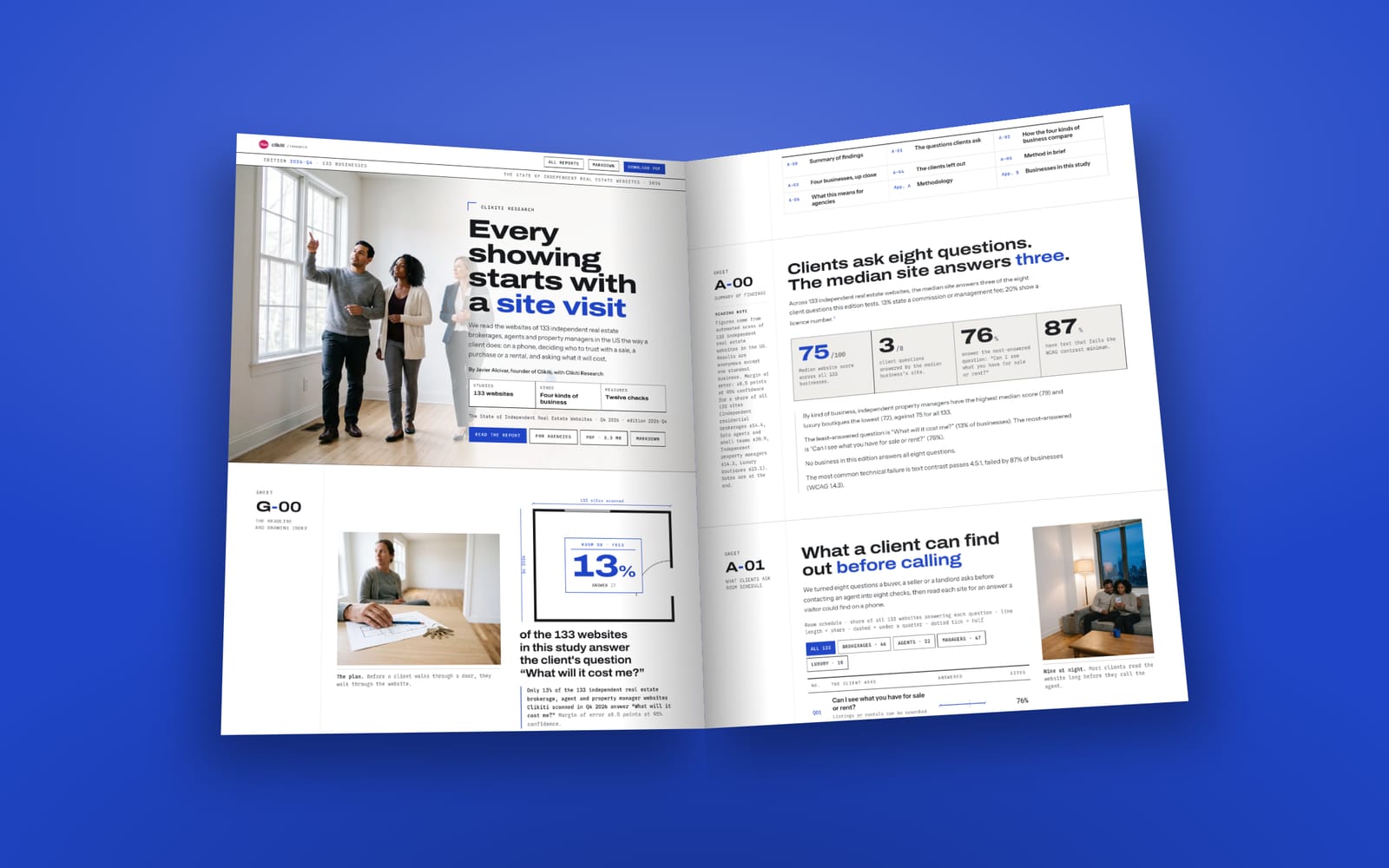
Agents and lawyers both sell trust before a decision a client can't easily undo. Set side by side, 133 independent real estate sites show a licence number on 20% and a fee on 13%; 125 small law firm sites state an admission on 43% and a consultation cost on 54%.
- Only 20% of 133 independent real estate websites show a licence number, against 43% of 125 small law firm websites that state where their lawyers are admitted (Clikiti Research, October 2026).
- Cost is the widest gap: 13% of real estate sites state a commission or management fee, and every one of the solo agent, team and luxury sites states neither; 54% of law firm sites say what a first consultation costs.
- Real estate is level or ahead on the rest: 40% against 45% on client reviews, and 58% offer a free home valuation, the agent's version of the free consultation.
A home sale and a legal matter look alike from the client's chair. There is a large sum or a large consequence, one professional to choose, and a shortlist made on a phone before anyone calls. Both trades sell trust, and both websites are where that trust is first tested.
Clikiti Research has measured both markets against the questions their clients ask. The State of Independent Real Estate Websites 2026 covers 133 independent brokerages, solo agents and teams, property managers and luxury boutiques. The State of Law Firm Websites 2026 covers 125 small law firms. On the four questions the reports share, real estate trails on credentials and cost: 20% of real estate sites show a licence number, against 43% of law firm sites that state an admission.
of the 133 websites we scanned answer “Are you licensed?” (a real estate licence number is shown).
The four shared questions, side by side#
Share of sites that answer each question, from each report's published data:
| Client question | Real estate (133 sites) | Law (125 sites) |
|---|---|---|
| Are you licensed? | 20% | 43% |
| What will it cost? | 13% | 54% |
| Do past clients vouch for you? | 40% | 45% |
| How do I reach you? | 60% | 39% |
The rules behind each row are close but not identical, and the differences matter. They are set out question by question below. The margin of error on each full sample is 8.5 points for real estate and 8.8 for law, so the reviews row is within the margin and the other three gaps are well outside it.
The technical checks use the same standards in both reports:
| Technical check | Real estate | Law |
|---|---|---|
| Text contrast fails 4.5:1 | 87% | 86% |
| Slower than 2.5 s on a phone | 77% | 68% |
| No structured data for the business | 78% | 42% |
| Images missing text descriptions | 29% | 12% |
The median overall score is 75 for real estate and 76 for law. The two markets build the same quality of website. What differs is what that website says.
Credentials: a number against a sentence#
The law rule passes when a lawyer's page or the about page states where the lawyers are admitted to practise. The real estate rule asks for more: a licence number on the home, about, agents or contact page. An MLS member number or a mortgage NMLS number doesn't count.
So part of the gap is the rule. A law firm passes with a sentence; an agent needs a number. That number exists for every licensed agent and broker, and the agent already has it. Putting it on the page is a one-line footer edit.
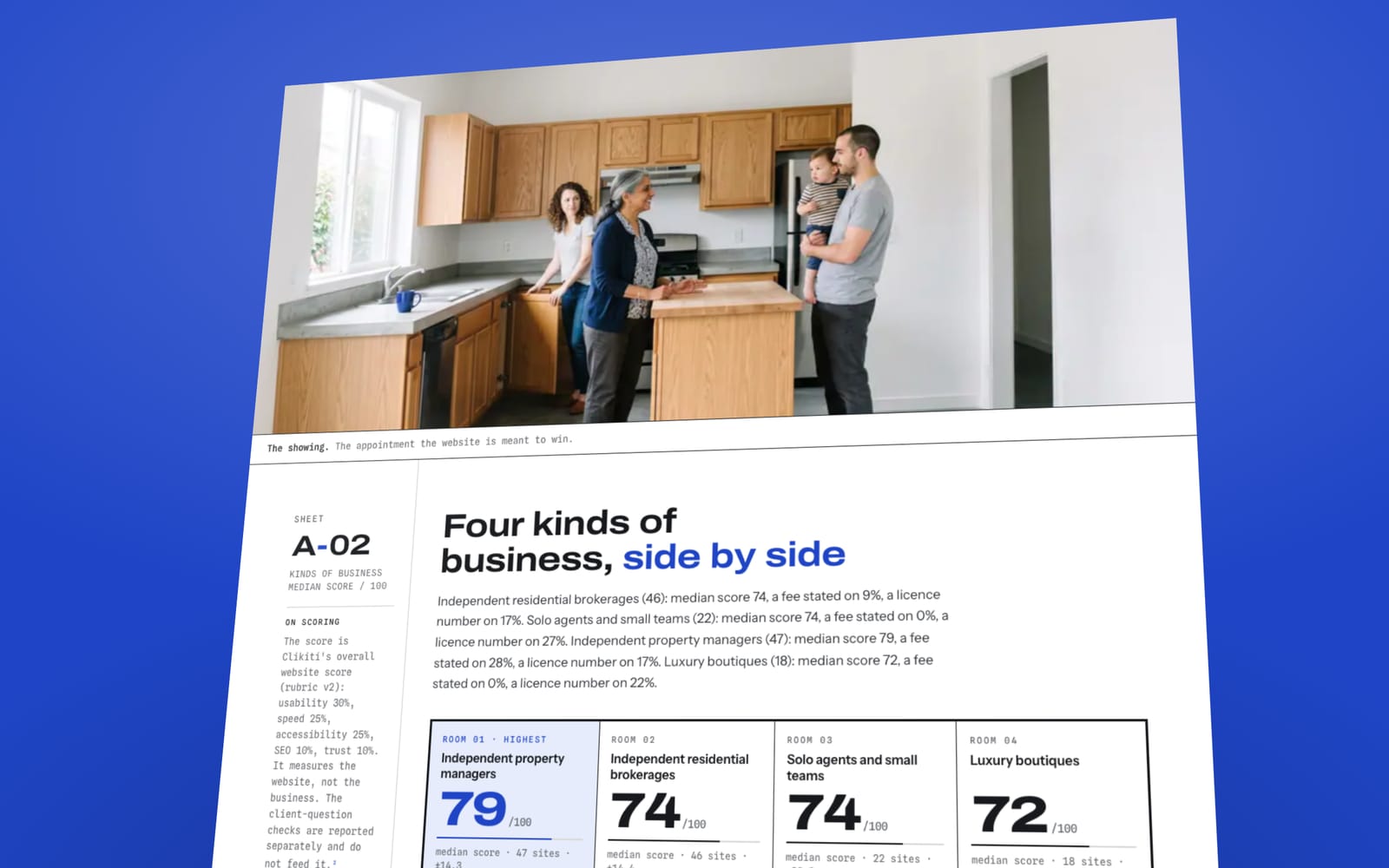
By kind of business, solo agents and small teams show it most often, on 27% of their sites. Luxury boutiques follow at 22%, and brokerages and property managers both sit at 17%.
Cost: the widest gap of the four#
Law firms pass by stating what the first conversation costs, and "free" is a cost. A free consultation, a fixed fee or "no fee unless we win" all count. 54% of the law sites say one of them.
The real estate rule wants a commission, a listing fee or a management, leasing or placement fee, as a percentage or a dollar amount. 13% of the sites state one, and most of the passes come from one group:
| Kind of business | States a fee |
|---|---|
| Independent property managers | 28% |
| Independent residential brokerages | 9% |
| Solo agents and small teams | 0% |
| Luxury boutiques | 0% |
Property managers account for most of the passes. On the sales side, not one solo agent, team or luxury site in the study states a commission.
There is a closer match to the lawyer's free consultation, and real estate does well on it. 58% of the sites offer a home valuation or, for managers, a rental analysis. That is the agent's free first step, and it appears about as often as the law firm's consultation line. What agents don't publish is the second answer: what the client pays once they sign.
Reviews: level, under a looser rule#
40% of real estate sites show client reviews, against 45% of law firm sites. The real estate rule is the more generous one: it counts two or more quoted testimonials where the page presents client reviews, as well as review markup and widgets. The law rule counts only markup and widgets, so the two numbers are not a like-for-like contest.
Luxury boutiques are the exception: 67% of them show reviews, and the same share shows a sales record. The luxury segment is where real estate sites prove their claims most often.
Contact: real estate ahead, on a different test#
This is the one row where real estate leads, 60% against 39%. The two rules ask different things. Real estate passes on a tappable phone number plus a contact form or a showing request. Law passes on a tappable phone number plus office hours, round-the-clock availability or a stated response time.
So the honest reading is narrow. Agents are better at offering a way in. Law firms are better at saying when someone will answer. Neither report measures the other market's half of that question.
Share of sites that answer each question
133 websites · Independent Real Estate · Q4 2026
What does it mean for an agency selling to both?#
If your client list has law firms on it, you already have the argument for real estate. The two cheapest fixes in the real estate report are the two lines law firms publish more often:
- The licence line. A number in the footer and on each agent page. 80% of real estate sites don't have one.
- The cost line. For property managers, the management and leasing fee. For agents, how they are paid and when that is agreed, with the rate or a starting point. 87% of sites say nothing.
The law posts show how short these lines can be: our eight client questions scorecard has the pass rule for each. For the agent page itself, built to answer the licence, record and review questions at once, see the agent page, measured.
How do you pitch it?
- Lead with the licence. It is the cheapest fix in the report and the one a careful client checks first. The rule is a number on the page, not a logo.
- Use the law comparison sparingly. "Lawyers, who sell the same kind of trust, show their credentials twice as often" is a fair line once, in a proposal, not on the first call.
- Price the fee page separately. It needs the owner's decision on what to publish, and that conversation takes longer than the build.
A careful client checks the licence first, and your site makes them look it up elsewhere.
Keep reading
More on real estate and the same problems in other industries

The agent page, measured: a spec for the 80% of sites with no licence number

72% of salon websites take bookings online. 42% say what happens if you cancel.
The inquiry email couples write because 91% of venue sites don't show open dates
How to cite
Clikiti Research (2026, October 15). Real estate websites trail law firms on licences and fees. Clikiti. https://splash.clikiti.com/research/posts/realestate-vs-law-websites-trust
Data and license
Every number comes from The State of Independent Real Estate Websites 2026 (n = 133). Free to reuse under CC BY 4.0. Credit Clikiti with a link. Plain Markdown
About the images
People in the photographs on this page are AI-generated. No real person, school, firm or practice is shown. Last updated Oct 15, 2026.
One stat. One pitch. Every Tuesday.
A finding from our scans, what it means for the agencies selling to that industry, and the line to open a pitch with. Free.