
Build sheet: the insurance page 72% of dental practice websites don't have
72% of the 135 independent dental practice websites we scanned don't say which insurance they take. Here is the page to build, section by section, with copy the practice can adapt.
- Only 28% of 135 independent dental practice websites say which insurance they take (Clikiti Research, October 2026).
- The same page can answer the two questions even fewer sites answer: whether the practice is taking new patients (22%) and what a visit costs (23%).
- It is a content job: one page, built from the plan list the front desk already uses, linked from the home page.
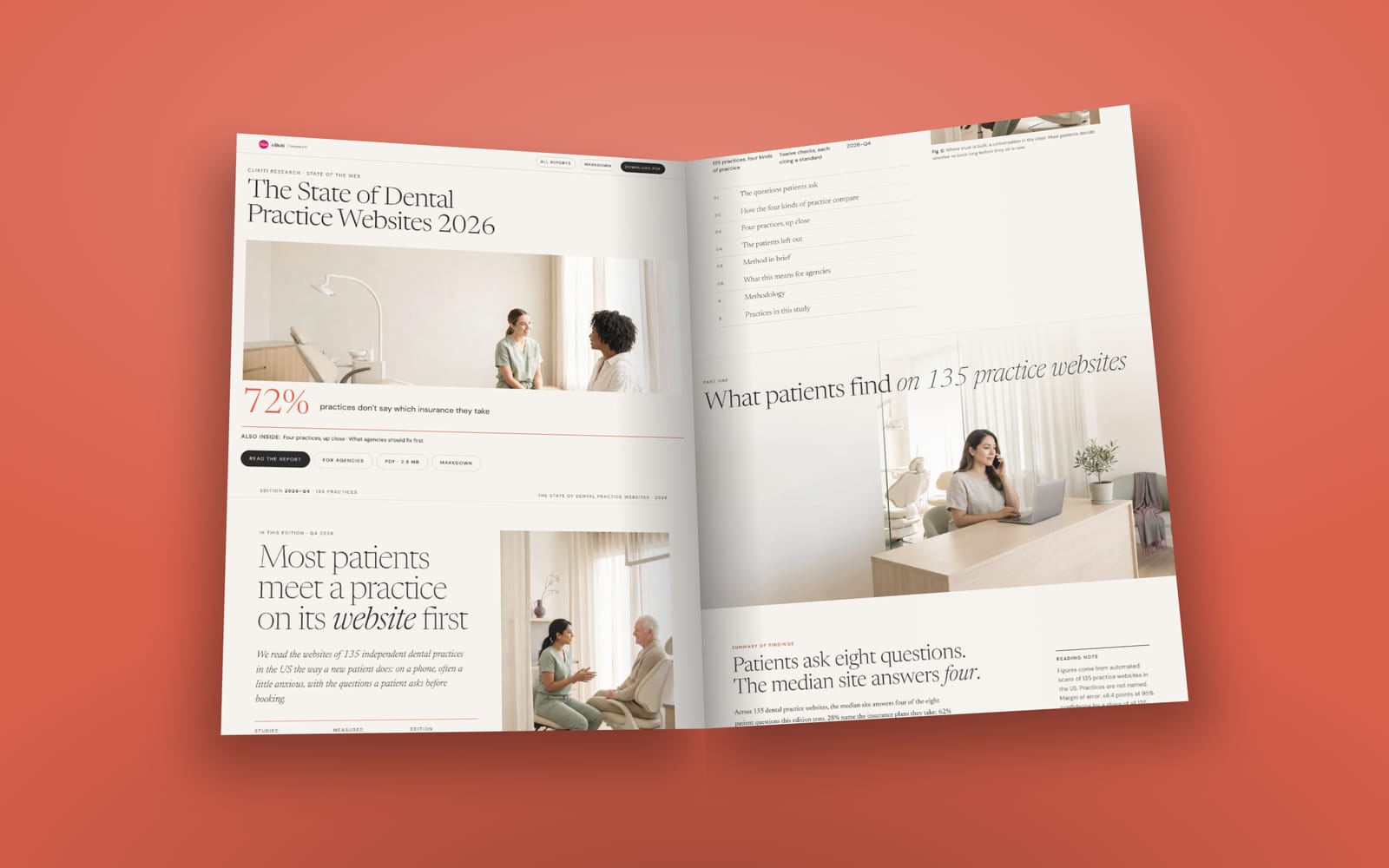
Open an independent dental practice's website on a phone and look for the list of insurance plans it takes. That is the check a new patient runs before deciding whether to call, and it is the one most practice websites fail.
In The State of Dental Practice Websites 2026, Clikiti Research scanned 135 independent dental practices: general and family, orthodontic, pediatric, and cosmetic and implant. Only 28% say which insurance they take. The other 72% leave the answer to the phone.
of the 135 websites we scanned answer “Do you take my insurance?” (says which insurance it takes).
Our finding post on dental insurance made the case for leading a pitch with this gap. This post is the build sheet: the page itself, section by section, with copy written the way it should read on the finished page, where to link it from and how long it takes. The insurer names below are common US dental plans used as examples; the practice's own list replaces them.
What counts as a pass?#
The scan reads the home page, then the best-matching link for insurance and payment. A site passes when it names at least one plan or network the practice takes, or says plainly that it takes no insurance. A line like "we accept most major plans" names nothing, so it doesn't pass.
Two other checks fit on the same page. Only 22% of the sites say whether the practice is taking new patients, and only 23% tie a dollar amount to an exam, a treatment or a membership plan. One page, built well, answers all three.
The page, section by section#
1. The answer, first
The headline and first sentence answer the question before anything else. There are two versions, depending on how the practice works.
Insurance we accept. We're in network with Delta Dental, Cigna, MetLife and Guardian. If your plan is on this list, we file the claim for you and you pay only your share at the visit.
We're a fee-for-service practice. We aren't in network with any insurance plan. You pay at your visit, and we give you an itemized receipt to send to your insurer.
Either one passes. The second is just as useful to a patient as the first, because it tells them what happens before they call.
2. The full plan list
List every plan by name, in plain text. A wall of insurer logos looks tidy, but a patient can't search it for their plan's name, and the scan reads the text of the page. Add the date the list was last checked, so the practice has a reason to keep it current.
Plans we're in network with (list checked October 2026): Aetna, Cigna, Delta Dental PPO, Guardian, MetLife, United Concordia. Plans change during the year. If you're not sure about yours, call us and we'll check it before you book.
3. If the plan isn't listed
This is the line that keeps an out-of-network patient on the page instead of moving on to the next practice.
Don't see your plan? You can still see us. We'll give you an itemized receipt to send to your insurer, and if you call with your plan details first, we'll tell you what you're likely to pay before your first visit.
4. No insurance: what a visit costs
"What will it cost?" is the second-least answered question in the study. To pass, a dollar amount has to be tied to a visit, a treatment or a membership plan. Financing limits and "save up to" claims don't count. Patients without insurance are the ones this section is for.
The section itself is short: the price of a new-patient visit (exam, X-rays and cleaning) as one figure, then the membership plan with its monthly cost and what it covers, usually two exams and cleanings a year, X-rays and a discount on other treatment. Use the practice's own figures. A starting price ("from") passes as well as an exact one.
No insurance? Our new-patient visit includes an exam, X-rays and a cleaning for one fixed price, so you know the cost before you sit down. If you'd rather spread it out, our membership plan covers your routine care for a monthly fee and takes a discount off other treatment.
If the practice won't publish fees, the membership plan alone is enough to pass, and it is often the easier conversation with the dentist.
5. Are you taking new patients?
This is the least answered question of the eight: only 22% of sites say. A menu item labelled "New patients" doesn't count. The report's fix is one plain line on the home page, with a sentence on what the first visit involves. Put the same line on the insurance page, because that's where a new patient lands.
We're welcoming new patients. Your first visit includes an exam, X-rays and a cleaning, and we'll talk you through any treatment and its cost before we start.
6. The next step
End with the way to book. Most practices already have this: 62% of the sites let patients book or request a visit online, and 79% state their opening hours. Reuse both here.
Ready to book? Book online any time, or call us during opening hours. Bring your insurance card, or tell us your plan when you book and we'll check it for you.
Where does it link from?#
A page that nobody can reach doesn't answer anything. Link it from:
- The home page, in the main menu and once in the first screen. The scan follows links from the home page, and so do patients.
- The new-patient page and the booking page, next to the button.
- The footer, beside the phone number.
Call the link what a patient types: "Insurance and payment" or "Insurance we accept". "Patient resources" hides it.
Share of sites that answer each question
135 websites · Dental practices · Q4 2026
How long does it take?#
The report rates the insurance page and the new-patient line as quick fixes, and prices as a content job. In practice, most of the time goes on getting the information, not on building the page.
Ask for three things in one email: the plan list the front desk uses on the phone, the fees for a new-patient exam and cleaning (or the membership plan's monthly cost), and whether the practice is taking new patients at each location. Once you have those, the page is a few hours of writing and layout on any site builder. Approval is usually one read-through by the office manager, who knows the list better than anyone.
Build it on the practice's existing template. This is a content page, not a redesign, and it should look like it has always been there.
How do you pitch it?
- Ask for the list, not a meeting. Tell them you'd like the plan list their front desk reads out on the phone. It's the only input the page needs, and asking for it shows you've looked at their site.
- Show three gaps on one page. Across the 135 practices, 72% don't name their insurance, 78% don't say whether they take new patients and 77% show no price. One page closes all three on their site.
- Price it as a small, fixed job. Then name the follow-on: 91% of the practice sites take longer than 2.5 seconds to load on a phone, and that's a bigger build.
Your front desk reads out the insurance list on the phone every day. Put it on one page and link it from your home page.
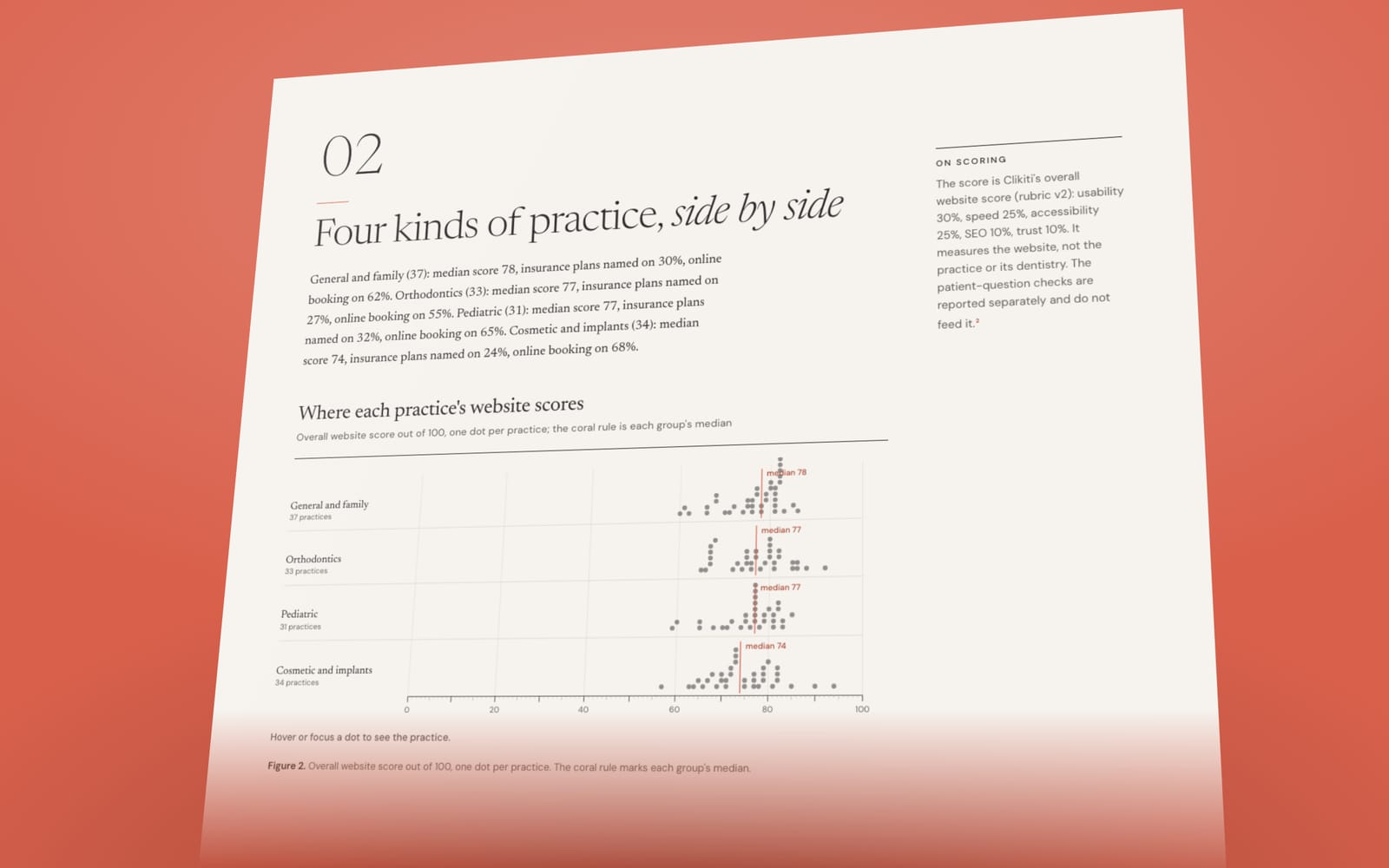
The page works because it answers the questions the practice already answers on the phone, all day, in writing that a patient can find at any hour. If you sell to law firms too, the same idea fits in a header there: one line on when someone will answer. The full dental numbers, by type of practice, are in the report.
Keep reading
More on dental and the same problems in other industries


How to cite
Clikiti Research (2026, October 15). Build sheet: the insurance page 72% of dental practice websites don't have. Clikiti. https://splash.clikiti.com/research/posts/dental-insurance-page-build-sheet
Data and license
Every number comes from The State of Dental Practice Websites 2026 (n = 135). Free to reuse under CC BY 4.0. Credit Clikiti with a link. Plain Markdown
About the images
People in the photographs on this page are AI-generated. No real person, school, firm or practice is shown. Last updated Oct 15, 2026.
One stat. One pitch. Every Tuesday.
A finding from our scans, what it means for the agencies selling to that industry, and the line to open a pitch with. Free.