Repair shop, tire shop, body shop, car lot: where their websites part ways
We scanned 174 independent auto websites in four groups. Their scores sit within five points. On price, warranty, qualifications and booking, the trade each one is in decides what its site says.
- Only 29% of 174 independent auto shop and used-car dealer websites show any price: a service, a fee, a labour rate or a car (Clikiti Research, October 2026).
- 40% state a warranty with its terms, 47% name a qualification such as ASE or I-CAR, and 56% let a driver book, ask for an estimate or set up a test drive online.
- The four kinds of business score within five points of each other. What splits them is which of these questions their trade makes easy to answer.
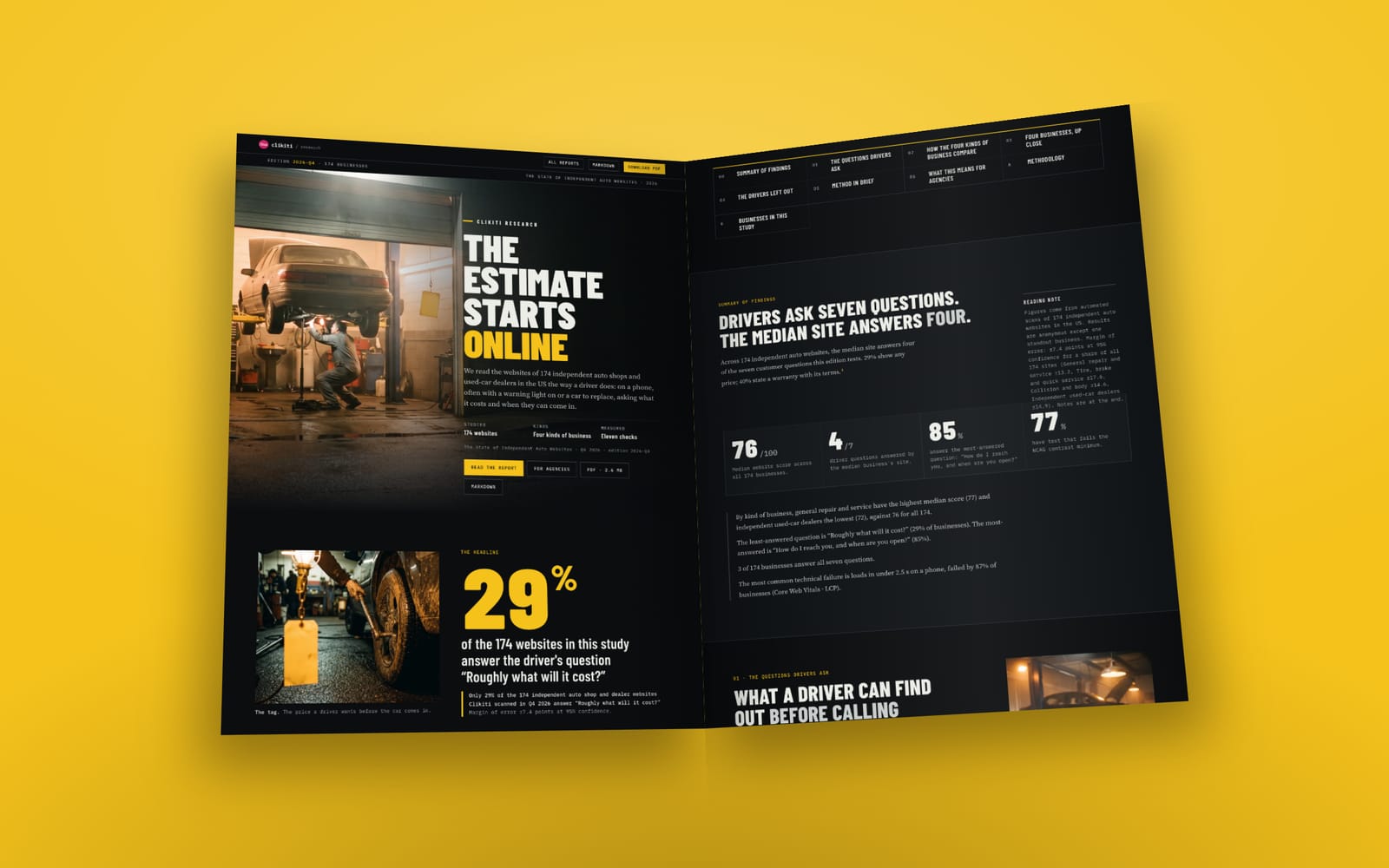
A general repair shop, a tire and brake shop, a body shop and a used-car lot all get filed under "auto". They don't sell the same thing, and they don't sell it the same way. The State of Independent Auto Websites 2026 scanned 174 of their websites, and the overall scores make them look alike. The answers to the questions drivers ask do not.
The headline of the study: only 29% of the 174 sites show any price, whether for a service, a fee, a labour rate or a car. That one number covers four very different counters.
of the 174 websites we scanned answer “Roughly what will it cost?” (a price shown: a service, a fee, a labour rate or a car).
The numbers first#
The sample, by kind of business:
| Kind of business | Sites | Median score | Under 60 |
|---|---|---|---|
| General repair and service | 55 | 77 | 0% |
| Tire, brake and quick service | 31 | 76 | 0% |
| Collision and body | 45 | 76 | 0% |
| Independent used-car dealers | 43 | 72 | 5% |
The score measures speed, accessibility, usability, search and trust. The customer questions are reported apart from it and don't feed it. So the table says these four groups build much the same kind of website. Dealers trail by a few points and are the only group with sites under 60.
The four questions where the trades pull apart, as the share of sites that answer each:
| Question | All 174 | Repair | Tire and brake | Body | Dealers |
|---|---|---|---|---|---|
| Roughly what will it cost? | 29% | 22% | 19% | 4% | 72% |
| Do you stand behind the work? | 40% | 58% | 35% | 56% | 2% |
| Are you qualified? | 47% | 78% | 48% | 44% | 7% |
| Can I book without calling? | 56% | 64% | 61% | 44% | 56% |
What passes: a dollar price for a named service, a fee, a labour rate, or a car next to its model year; a warranty with terms (months and miles, years, lifetime or nationwide); a named qualification (ASE, I-CAR, AAA Approved, a carmaker's certification, a parts network, BBB or NIADA); and a way to book service, request an estimate or schedule a test drive online.
Price: a car has a sticker, a repair has a diagnosis#
71% of the sites show no price. That share is made up very unevenly: 72% of dealer sites show one, against 22% of repair shops, 19% of tire and brake shops and 4% of body shops.
Used-car dealers show prices more than three times as often as any of the shops. A lot sells a finished thing that already has a number on it, and that number is the listing. Every car on the lot gets compared on price somewhere, so the price goes on the site as a matter of course.
Repair shops sell a diagnosis first and a job second. An owner won't quote a brake job on a car they haven't seen, and that is a fair position. But the rule doesn't ask for that. It passes on a diagnostic fee or a labour rate, numbers the shop charges every customer the same and already says out loud at the counter.
Tire, brake and quick service shops sell the most standard work in the trade: an oil change, an alignment, a set of tyres fitted. Those are the easiest jobs to put a starting price on, and 81% of the sites show none. Joey's Auto Shop in Des Moines, a tire, brake and quick service shop and the best site in the study, answers every customer question the study asks except this one.
Body shops almost never show a price: 4% do. Their work starts with an estimate on a damaged car, and the bill is often settled through an insurance claim. That explains the gap. It doesn't change the rule: a body shop can still publish what an estimate costs, even if the answer is that it costs nothing.
Warranty: shops make promises, lots mostly don't#
60% of the sites don't state a warranty with its terms. A line that says "we stand behind our work" doesn't pass. The rule wants months and miles, years, or lifetime.
Repair and body shops are where the warranty lines are: 58% of repair sites and 56% of body shop sites state one with terms. A repair shop's guarantee on parts and labour often comes from the parts network it belongs to. Body shops commonly offer a lifetime warranty on paint and body work. That still leaves more than 40% of each silent on a promise the shop is already making. Tire and brake shops sit lower, at 35%.
Dealers state warranty terms on 2% of their sites. Used cars are often sold with no warranty or with a separate service contract, and the study doesn't judge any dealer's terms or whether they meet licensing rules. For an agency, it means the warranty pitch belongs to the shops.
Qualifications: the badge depends on the trade#
53% of the sites name no qualification at all. Which badge counts depends on the trade.
Repair shops have ASE, the trade's own certification, and 78% of their sites name a qualification. Body shops have I-CAR and carmakers' certifications, which matter to insurers and to owners of newer cars, yet only 44% name one. Tire and brake shops sit at 48%. Dealers have few badges to show beyond BBB and NIADA membership, and 7% of their sites name one.
So on a repair shop's site, a missing ASE line is a gap the owner will recognise straight away. On a dealer's site, it isn't the conversation to open with.
Booking: an appointment, an estimate, a test drive#
44% of the sites give a driver no way to book, ask for an estimate or set up a test drive without calling. Each trade books something different. Repair and tire shops book bay time, so a booking button suits them: 64% and 61% offer one. A dealer books a test drive, and 56% of dealer sites let a buyer ask for one. A body shop books an estimate, and 44% of its sites take that request online.
Read the body shop number with care. The scan reads each page as the server sends it, and it doesn't test multi-step estimate forms or anything a script draws after the page loads. Some body shops will have an estimate form the scan couldn't see. Open the site on a phone and check before you raise it.
What this changes before a call#
Name the kind of business before you open the site, then go to the question its trade makes easiest to answer:
- General repair: the diagnostic fee or the labour rate, and the ASE line.
- Tire, brake and quick service: starting prices for the standard jobs.
- Collision and body: the warranty with its terms, and the I-CAR or carmaker certifications.
- Used-car dealers: the price is usually there already. Lead with reviews instead: only 23% of dealer sites show any, against 64% of repair shops.
Dental practices have the same blind spot on cost: only 23% of dental sites show a price, and the reasons a dentist gives sound a lot like a repair shop's. Every question, with the method, the sample and the split by kind of business, is in the full automotive report.
Keep reading
More on automotive and the same problems in other industries
Talk track: getting an independent repair shop to put its prices online

72% of salon websites take bookings online. 42% say what happens if you cancel.

The inquiry email couples write because 91% of venue sites don't show open dates
How to cite
Clikiti Research (2026, October 15). Repair shop, tire shop, body shop, car lot: where their websites part ways. Clikiti. https://splash.clikiti.com/research/posts/auto-websites-four-kinds-compared
Data and license
Every number comes from The State of Independent Auto Websites 2026 (n = 174). Free to reuse under CC BY 4.0. Credit Clikiti with a link. Plain Markdown
About the images
People in the photographs on this page are AI-generated. No real person, school, firm or practice is shown. Last updated Oct 15, 2026.
One stat. One pitch. Every Tuesday.
A finding from our scans, what it means for the agencies selling to that industry, and the line to open a pitch with. Free.